All Post By

Demo Account

Private Tutoring and Mainstream Education Linkages in India: A Political Economy Approach

On July 12, Shadow Education SIG members gathered on Zoom to listen to a presentation by Miss Shalini Bhorkar on Private Tutoring and Mainstream Education Linkages in India: A Political Economy Approach. 

Currently, Shalini is a doctoral candidate at the Institute of Education, UCL. She is also an HKU graduate from the Comparative and Global Studies in Education and Development (CGSED) MEd program.

Attendees included the SIG members from Hong Kong, Mainland China, the UK, Uzbekistan and Japan.

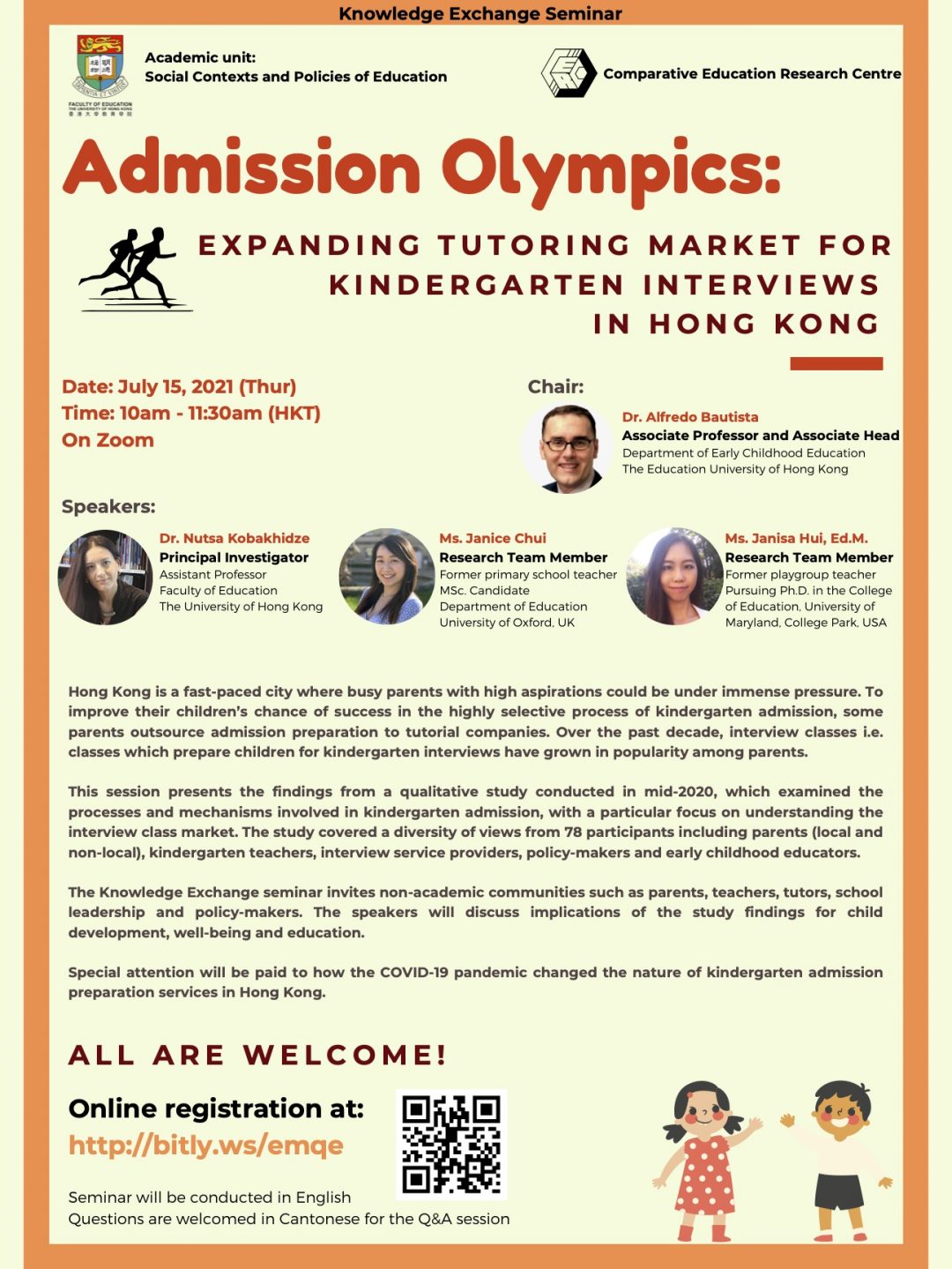
Admission Olympics: Expanding Tutoring Market for Kindergarten Interviews in Hong Kong

Date: July 15, Thursday, 2021
Time: 10 am to 11:30 am HKT 

Zoom Registration link: https://hku.zoom.us/meeting/register/tJItcOyrqDooHt2ffGWUwg-kxJGnlfcohtSK


Chair: 
Dr Alfredo Bautista, Associate Professor and Associate Head, Department of Early Childhood Education, The Education University of Hong Kong

Speakers: 
Dr Nutsa Kobakhidze, Principal Investigator, Assistant Professor, Faculty of Education, The University of Hong Kong
Ms Janice Chui, Research Team Member, Former Primary School teacher, MSc. Candidate in the Department of Education, Oxford University, UK
Janisa Hui, Ed.M. Research Team Member, Former Playgroup Teacher. Pursuing PhD Degree in the College of Education, University of Maryland – College Park, USA

Hong Kong is a fast-paced city where busy parents with high aspirations could be under immense pressure. To improve their children’s chance of success in the highly selective process of kindergarten admission, some parents outsource admission preparation to tutorial companies. Over the past decade, interview classes i.e. classes which prepare children for kindergarten interviews have grown in popularity among parents.

This session presents the findings from a qualitative study conducted in mid-2020, which examined the processes and mechanisms involved in kindergarten admission, with a particular focus on understanding the interview class market. The study covered a diversity of views from 78 participants including parents (local and non-local), kindergarten teachers, interview service providers, policy-makers and early childhood educators.

The Knowledge Exchange seminar invites non-academic communities such as parents, teachers, tutors, school leadership and policy-makers. The speakers will discuss implications of the study findings for child development, well-being and education. Special attention will be paid to how the COVID-19 pandemic changed the nature of kindergarten admission preparation services in Hong Kong. 

CERC Management Committee meeting

On June 9, 2021 the CERC Management Committee met to discuss the 2020-2021 annual report and prospects of international projects and collaborations in the next academic year.

On June 17, 2021, CERC will hold its Annual General Meeting. The meeting will start at 12.15 with a report from the Management Committee and will conclude with a talk “On Teaching Comparative Education in Asia: Selected Portraits and Features” by Professor Sheng-Ju Chan, National Chung Cheng University, Taiwan (12.45-13.45).

In the picture above, [sitting, from left to right], Mark Bray, UNESCO Chair and a former CERC Director, Liz Jackson, EduHK Professor of International Education and a former CERC Director, and Yang Rui, Professor of Chinese Higher Education and Associate Dean-Research, Faculty of Education; [standing, from right to left], Nutsa Kobakhidze, MC member and convener of SIG-Shadow Education, Peter Cobb, MC member, Anatoly Oleksiyenko, CERC Honorary Director and convener of SIG-Higher Education, and Alex Fedorov, Interim Secretary.

All AGM participants will enjoy a limited-time offer – 50% off on all CERC books and monographs.

To register for the AGM, please use this Zoom registration link: https://hku.zoom.us/…/tJUrcuivqz4qHtOmJ5w9-TWlP18lG5PJNBtj

French-language edition of Shadow Education Book discussed by Ministers of Education in Africa

On 15 April 2021, CONFEMEN (Conférence des ministres de l’Éducation des États et gouvernements de la Francophonie), which is headquartered in Senegal, hosted high-level webinar focused on the CERC book written by Mark Bray L’éducation de l’ombre en Afrique (i.e. the French translation of the book Shadow Education in Africa: Private Supplementary Tutoring and its Policy Implications).

The event was co-hosted by France Éducation International, which is an arm of the French government responsible for international relations in the education sector. 

Following introductions by CONFEMEN Secretary-General Abdel-Rahamane Baba-Moussa and FEI Director-General Pierre-François Mourier, Mark Bray presented the book. Then six Ministers of Education and/or their representatives spoke, namely: 

  • Chad: Aboubakar Assidick Tchoroma,
  • Gabon: Camelia Ntoutoume-Leclerq,
  • Guinea: M. Bah,
  • Guinea Bissau: Arcenio Adulai Baldé, 
  • Senegal: Chaikana Lam, and
  • Togo: Dodzi Kokoroko.

Other speakers included:

  • Alioune Sall, Director of the African Futures Institute (AFI), 
  • Manos Antoninis, Director of UNESCO’s Global Education Monitoring Report, 
  • David Atchoarena, Director of the UNESCO Institute for Lifelong Learning, and  
  • Koumbou Boly Barry, Chief of Education in ICESCO, and United Nations Special Rapporteur on the Right to Education.

All speakers recognized the need to focus more clearly on private supplementary tutoring, especially in the context of social inequalities. More data are needed and wider discussion in order to ‘take the topic out of the shadows’. 

Reaching Audiences through Different Media

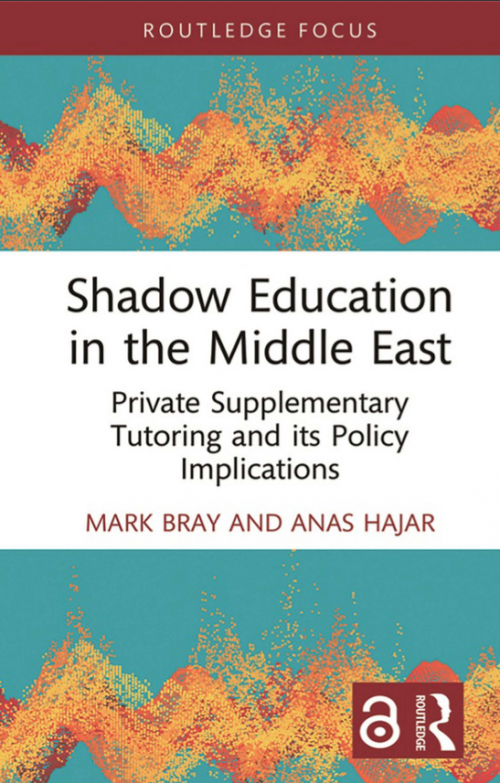
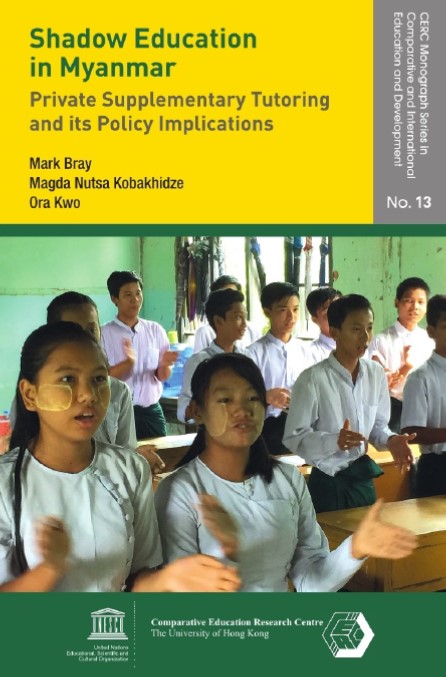
Following the launch of the CERC book Shadow Education in Africa: Private Supplementary Tutoring and its Policy Implications, efforts have been made to reach diverse audiences. Two channels for doing so are:

The book is also the focus of a FreshEd podcast during which Professor Bray was interviewed by Will Brehm. 

The FreshEd interview was wide-ranging, and touched on Brehm’s own studies of private tutoring in Cambodia. His book Cambodia for Sale: Everyday Privatization in Education and Beyond has just been published by Routledge. It is based on his PhD thesis completed at the University of Hong Kong. The remarks during the podcast showed some similarities between parts of Africa and of Southeast Asia. 

2021 annual conference of the Comparative Education Society of Hong Kong

As a co-sponsor of the 2021 annual conference of the Comparative Education Society of Hong Kong, CERC welcomes comparative education researchers from around the world. The greeting message from Dr. Anatoly V. Oleksiyenko, CERC Director can be watched below.

This year’s theme is “Geopolitics of Knowledge and Education Policy”. The schedule and registration details are available at https://sites.google.com/view/ceshk-conference-2021/home (Zoom links embedded). You can still sign up!

https://www.youtube.com/watch?v=0kaICtMStAY

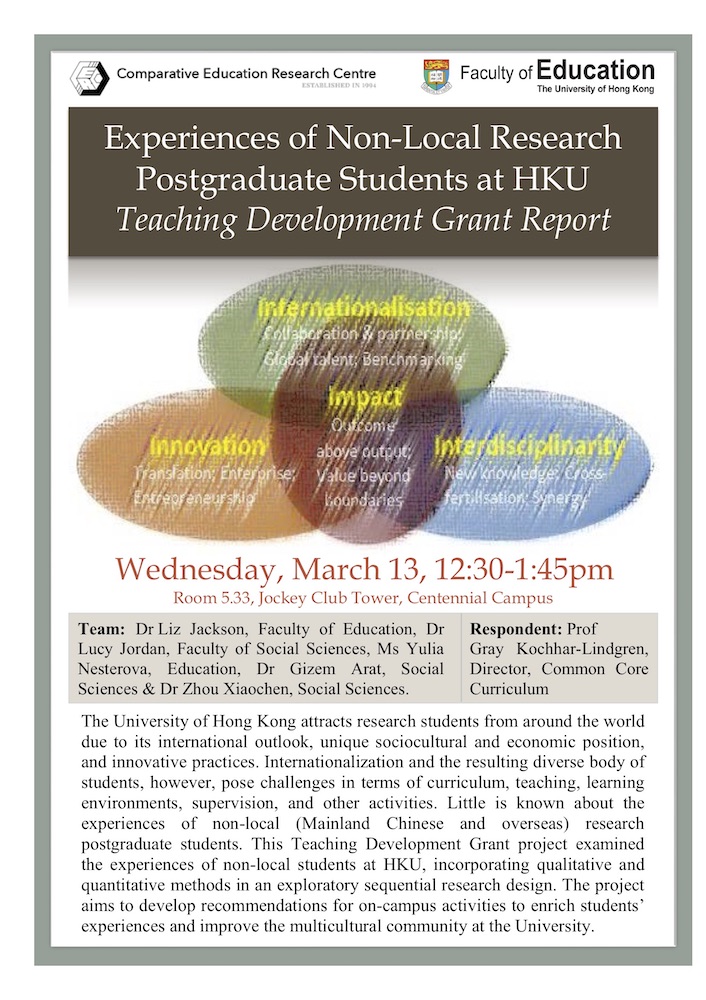
Experiences of Non-Local Research Postgraduate Students at HKU Teaching Development Grant Report

Team: Dr Liz Jackson, Faculty of Education, Dr Lucy Jordan, Faculty of Social Sciences, Ms Yulia Nesterova, Education, Dr Gizem Arat, Social Sciences & Dr Zhou Xiaochen, Social Sciences.

Respondent: Prof Gray Kochhar-Lindgren, Director, Common Core Curriculum

The University of Hong Kong attracts research students from around the world due to its international outlook, unique sociocultural and economic position, and innovative practices. Internationalization and the resulting diverse body of students, however, pose challenges in terms of curriculum, teaching, learning environments, supervision, and other activities. Little is known about the experiences of non-local (Mainland Chinese and overseas) research postgraduate students. This Teaching Development Grant project examined the experiences of non-local students at HKU, incorporating qualitative and quantitative methods in an exploratory sequential research design. The project aims to develop recommendations for on-campus activities to enrich students’ experiences and improve the multicultural community at the University.

Date: Wednesday, March 13, 2019
Time: 12:30 – 13:45
Venue: Room 5.33, Jockey Club Tower, Centennial Campus

“Profile of a Comparative and International Education Leader: Mark Bray” by W. James Jacob and Journal of the WCCES

Journal of the WCCES has recently published a bibliographical article about Professor Mark Bray and his distinguished career:

Mark Bray’s profile is a biographical sketch of his contributions to the field of comparative and international education (CIE). This profile also documents his distinguished career in which he rose to senior leadership positions in higher education and international development organizations including UNESCO. Mark served as President of the World Council of Comparative Education Societies (2004-2007), Director of UNESCO’s International Institute for Educational Planning (2006-2010), and as President of the Comparative Education Society of Hong Kong (CESHK) and the US-based Comparative and International Education Society (CIES). The article is based on multiple data gathering techniques and oral interviews. Highlights include a review of some of Mark’s key career milestones, leadership positions and accomplishments, as well as several publications that have helped shape and impact CIE worldwide.

We are attaching the full article for your convenient reading: Profile of a Comparative and International Education Leader: Mark Bray by W. James Jacob.

Freedom to Teach, Freedom to Learn: Higher Education and Human Dignity

Comparative Education Research Centre (CERC)/ Springer

Editors:
Anatoly Oleksiyenko & Liz Jackson

Freedom to teach and freedom to learn (Lehrfreiheit and Lernfreiheit) have become imperatives of research universities that followed the Humboldtian model of higher education and shaped the benchmarks for reputational performance, competition and hierarchical stratification over the last few decades. Freedom and responsibility have become a conflictual dichotomy in the studies of higher education as markets and hierarchies became two major domains shaping and distributing status goods in most societies. Defining a good in the context of international higher learning has become also problematic as freedoms of mobility, inquiry and argument implied strategizing often in disregard of ethics, politics, and social discourses. The literature in the field of global mobility and higher learning has provided a range of examples where advantages for some have been raising anxiety and competition for access to status goods worldwide. Alas, the literature has provided little insight into how freedom of teaching and learning comes into play with social responsibilities in various cultural domains and political systems.

With increasing influence of illiberalism, freedom should not be considered or interpreted lightly. Academic freedom, for example, has never been challenged as much as it is today when the post-truth societies primarily make universities battlefields of politicized emotions and expressions. At the same time, with intelligence commodified, reified or marginalized, the freedom of mobility can entail a fight for entitlements or an escape from local responsibilities. The decline of academic freedom or the absence of forces to defend it are related challenges. These challenges grow as the competition of ideas, sometimes under the rubric of academic freedom, often implies the power struggle and questioning of statuses in the so-called “marketplace of ideas”. Competition per se becomes more important than human dignity, which was originally supposed to expand and strengthen under freedoms to teach and learn. What had been happening to these freedoms across different subject positions and cultures of higher education, remains largely underexplored.

As the waves of globalization encourage rethinking the freedom to teach and the freedom to learn, this project will engage scholars from around the world to rethink the currency of ideas, concepts and practices related to dignity, freedom, independence, and responsibility in higher education. Are there sufficient freedoms to teach and to learn in modern colleges and universities these days? Are they linked effectively with academic responsibilities? Do these freedoms as they are perceived and/or practiced within and across diverse geographic contexts align effectively with requirements to enhance human dignity? How do freedom to teach and freedom to learn get shaped by relationships of students and scholars to each other and to structural aspects of higher education and the marketplace of ideas? What is still missing in the current discourse and applications in classrooms, online spaces, etc.? What are the implications of the presence or absence of these freedoms in the post-truth world, and the expanding illiberalism and hybrid wars? Developing critical responses to these and other questions through comparative research, will enhance our insight into how tensions between freedoms and responsibilities are managed and resolved in this “brave new world.”

We are inviting scholars of comparative and international higher education to participate in the CERC/Springer publication project. We look forward to receiving extended abstracts (circa 800 words) by August 1, 2019.