All Post By

wpadmin

Global or local identity? Nepalese students’ orientations towards learning English and Cantonese in Hong Kong

By Chura Bahadur Thapa

Chair: Mark Bray

This seminar will report on a qualitative study of the identities of 28 secondary school Nepalese students in Hong Kong schools. All participants were in English-medium classes and fluent in English, and some were also fluent in Cantonese. During the unstructured interviews and informal interactions as a form of ethnographic enquiry, participants were asked to talk about their English and Cantonese learning beliefs, their career prospects, and their English and Cantonese use inside and outside school. The participants displayed different orientations with regard to the learning of English and Cantonese, and constructed different types of identities. The seminar will include comments on government policies for minority students.

Chura Bahadur Thapa has been living in Hong Kong since 1996, and is an active member of the Nepalese community. He holds a Master’s Degree from Hong Kong Baptist University and a PGDE from the HKIEd. Before joining HKU as a research student, he was a teacher in a Chinese-medium DSS school which recruited ethnic minority students for English-medium classes.

Time: 12.45 – 14.00
Date: Friday 26 February
Venue: Runme Shaw 203

All are welcome!

CIES in Vancouver: Before-you-go Briefing and Sharing

Many academic staff and students will join the 60th anniversary conference of the Comparative & International Education Society (CIES) in Vancouver, Canada, 6-10 March 2016. This will be a special one for HKU, since Mark Bray is the President-Elect and an HKU team of students led by Nutsa Kobakhidze has a strong role in organizational matters.

The Comparative Education Research Centre (CERC) is organising a pre-meeting to provide some information on:

a)      the CIES (history, mode of operation),
b)      the conference (scale, organization),
c)      Vancouver (including tourist opportunities),
d)      each other (both students and academic staff).

In addition, the session will include some tips for successful presentations and networking.

Date: Monday 22 February
Time: 12.45-14.00
Place: Runme Shaw 202

We look forward to seeing you there.

1

Visit to a Japanese Juku

Yoko Yamato (CERC Associate Member, resident in Tokyo) and Zhang Wei (CERC Secretary and Postdoctoral Fellow) are conducting research on shadow education in Japan. This includes interviews with stakeholders in the industry, and visits to a number of jukus.

One of these jukus is called The Scientific Education Group (SEG). The company was formed in the 1980, and has established a strong reputation. Below are some observations from a visit in December 2015. 

The visit to SEG and observation of the combined classes of Extended Reading cum grammar and oral communication completely changed our impressions of English classes that may be conducted in jukus. The stereotype image of English tutoring classes is of a teacher explaining the grammar of selected sentences and getting the idea of a paragraph in Japanese, with students taking notes while listening. ‘Reading’ classes often turn out to be translation classes in which no real reading is involved. Since SEG’s Extensive Reading class has Reading in its name, we had been wondering what technique the instructor would use. It was eye-opening and indeed interesting: more like individual reading time for students.

What distinguished the class from independent reading in a library was that the books were IMG_0502provided by the instructor rather than being selected by the students themselves. Further, each student was given a CD player on which they listened to the CD which accompanied the book they were reading. The teacher closely checked each student’s reading progress, and selected books for next reading. This left the teacher no time to sit and rest, but was possible in a class of 11 students. The teacher’s major role was not to deliver knowledge but to screen useful learning materials, to monitor and to guide.
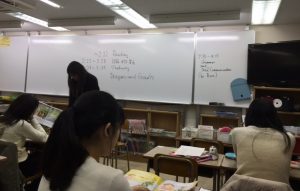
‘Book whisperer’ is the term Donalyn Miller, the author of The Book Whisperer: Awakening the Inner Reader in Every Child gave to this form of instruction. The class we observed was for Grade 7, when students first start learning English at school as a ‘subject’, though some private mainstream schools may have already introduced English from primary level. Public primary schools introduce English as ‘activities in another language’, not a subject at upper grades (though the contents, timing and syllabus differ from school to school). Students in the SEG class we observed seemed to enjoy reading silently while listening to the recording of the book or reading aloud in soft voice along with the CD. At the very beginning most students were just listening quietly, but later a boy started to follow loudly. Some other students were affected, and did the same. We attended an ER class conducted by Mr. Furukawa, the founder of SEG, and he said that students were free to read books in their own manner.
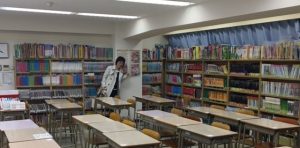
IMG_0524The range of books in this particular classroom was mainly for pre-primary to lower primary school children in the countries where English is the native language. The shelves supported as many as 20,000 books. As the grade progressed, so did the range of the books – even reaching unabridged Harry Potter books. Mr. Furukawa indicated that SEG invests US$500,000 on books every year. Close records of a student’s reading progress are also necessary. A handbook had been given to each student at the beginning of the program to track the books that had been read and the students’ reflections. The handbook is as much a reference for the teacher as a notebook for the students and a form of feedback to the parents.

The second half of the class was conducted by a British native speaker. It combined grammar, reading comprehension and writing. The instructor made use of Total Physical Response Storytelling (TPRS), involving the students actively by letting them make stories for the writing activities which followed. It was quite a task to open the students’ mouths, partly because the class was on the fourth day of a five-day special session for the winter holiday. Japanese students are seldom willing to express their ideas in public.
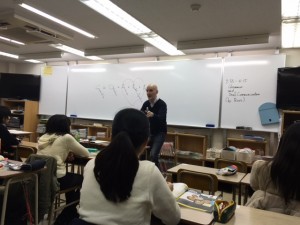
IMG_0513The teacher had to be an actor, entertainer, moderator, director and facilitator. He tried hard to make fun of himself and to cheer the students with body language. Sometimes students were not able to respond to his questions, and he would ask alternative questions in order to squeeze one or two words from them. He was good at using familiar examples, for instance about typical conversations when friends greet each other. This ended with a formula which students could use with anyone they intend to be friend and with a big heart on it (see photo).

As we observed, and learned from the students’ evaluations, the teacher was patient and ‘interesting’. His grammatical points did not seem to come in order of mainstream school syllabus and may not cover the entire grammar the students need to study in their schooling. The juku teachers can enjoy much freedom of teaching, partly because jukus are companies rather than public organisations subject to accountability requirements.

After the class, we talked with the teachers. The books levels are indeed lower than the students’ age levels, as they are picture books for pre-primary and lower primary students in English-speaking countries. But the students were learning to read books in a foreign language without consulting dictionaries, and the program enabled them to progress from easier to more difficult books.

Such reading of course can also be undertaken at home or in a library (which was our idea of how spare time can and should be spent, provided that a great number of good books are available). But SEG provided an atmosphere with peer influence and easily-accessible and carefully selected materials. The teacher felt that parents could provide the environment, but the approach would usually fail because they would usually give their children more difficult books than the children could read with pleasure. Because it is not examination-oriented, the Grade 7 students were able to enjoy their reading with little stress from time and the obligation to meet certain standards.

We were impressed that Mr. Furukawa, the founder, head instructor of ER and the president of SEG, was not looking for a short-term solution for passing an examination but a life-long mission of education: learning to learn, and learning to do. This applied not only to English but also to his own major, mathematics. Extensive reading can certainly equip students with solid foundations of a language, but it takes time. With such an approach some students might hit bottlenecks during the process so as to give up the practice. However, once they have the challenges, they may become more competent to learn the language independently and enjoy learning.

Yoko Yamato and Zhang Wei

6 January 2016

Education in Eritrea: Features, Challenges and Policy Goals

By Tedros Sium Mengesha

Chair: Mark Bray

Contemporary African education systems have their roots in colonial eras. Though it would be naïve to say that colonialism had no merits at all, colonial education in Africa was characterised by glaring injustice and inequalities. After independence, the various liberation movements proclaimed top priority to reconstructing education to meet the needs and realities of African societies. Yet, the realities remain far from the pioneering ambitions.

Focusing on education in Eritrea, this seminar will emphasise issues of inequality and social justice. Eritrea was an Italian colony between 1889 and 1941, was under British military administration for a decade, and merged with Ethiopia in 1952. The federation of Eritrea with Ethiopia was imposed against the wish of many Eritreans, and a war of liberation from Ethiopia led to Independence in 1993.

Like many other African nations which emerged from liberation wars, post-colonial Eritrea is still building an education system with a vision for reconstruction and development. Drawing on personal experiences and on empirical research for his PhD studies, Tedros Sium will highlight the features of the education system, key policy issues, and some of the constraints.

Tedros Sium Mengesha is a PhD student from Eritrea in the HKU Faculty of Education. His own schooling was organised in the bushes of armed struggle by Eritrean freedom fighters. Following Independence, he continued his education both locally and in the UK for Bachelor’s and MEd degrees. Immediately before coming to HKU, he was Director of the Human Resources Development Division in the Ministry of Education.

Date: Tuesday 12 January 2016

Time: 12.45 – 14.00

Venue: Room 202 Runme Shaw Building

All are welcome!

Honorary Doctorate for Ruth Hayhoe

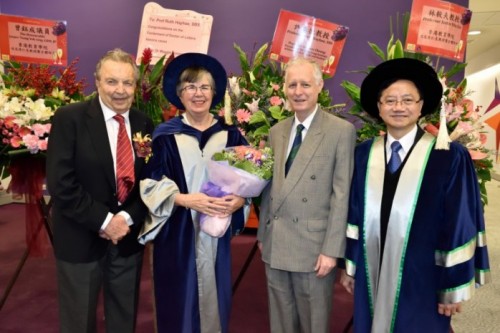
CERC is delighted that on 15 December 2015 one of its distinguished Associate Members, Prof. Ruth Hayhoe, was awarded an Honorary Doctorate by the Open University of Hong Kong (OUHK). The citation was read by Prof. Lee Wing-On, who was CERC’s first Director and is now Vice President of the OUHK.

Prof. Lee noted that Ruth Hayhoe is conversant with five languages, including Mandarin and Cantonese, and has devoted a lifetime to intercultural dialogue. Her autobiography published by CERC is entitled Full Circle: A Life with Hong Kong and China. It recounts how Ruth moved to Hong Kong from Canada in 1967 as a 21 year-old, working as a teacher in a local secondary school and undertaking much community work. She spent 11 years in Hong Kong during that period, “falling in love with Chinese people and Chinese culture”.

The next few years took Ruth Hayhoe to Shanghai, London, Toronto, Beijing and again Toronto, but in 1997 – the year that Hong Kong was reunited with China – she was appointed Director of the Hong Kong Institute of Education. This return to Hong Kong explains the title Full Circle. In 2002 she moved back to Canada – perhaps making a figure of eight – but she retains close contact with both Hong Kong and Mainland China.

CERC has published four other books written or edited by Ruth Hayhoe. They include Portraits of Influential Chinese Educators and Portraits of 21st Century Chinese Universities. As noted by Lee Wing-On, “one striking feature of Professor Hayhoe’s academic writing approach is story-telling”. For this pair of books she focused in individuals and institutions, while Full Circle is a deep and meaningful self-portrait.

In the picture above, Ruth Hayhoe is accompanied (left) by her husband, Walter Linde. Lee Wing On is on the far right, and between him and Professor Hayhoe is Mark Bray (HKU).


Welcoming a shadow education researcher from Europe

CERC has an international team focusing on the shadow education system of private supplementary tutoring. In November 2015, the team was pleased to welcome Vít Šťastný from Charles University in Prague. Vít is among the few Czech researchers working on this theme, in his fourth year of PhD studies. He found the resources to spend one month in CERC, and we feel that it was very beneficial for both sides. Below are some of Vít’s reflections.

Academic research on shadow education is still in its infancy in the Czech Republic. Therefore, I was very keen to visit CERC to discuss themes with other PhD scholars and with established researchers. My university indicated that it could provide financial support through its Mobility Fund at the university level and what is called SVV 22015-260228 at the faculty level. I was very pleased when Professor Mark Bray accepted my request to visit and allowed me to join CERC for one month.

On my first day, I presented findings from my research in the Czech Republic to members of the shadow education Special Interest Group (SIG). It was very valuable to discuss, compare and defend my results in a friendly and welcoming atmosphere; and by meeting the colleagues on the first day, I had immediately established contacts for follow-up discussion.

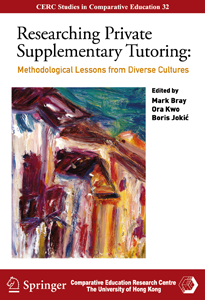
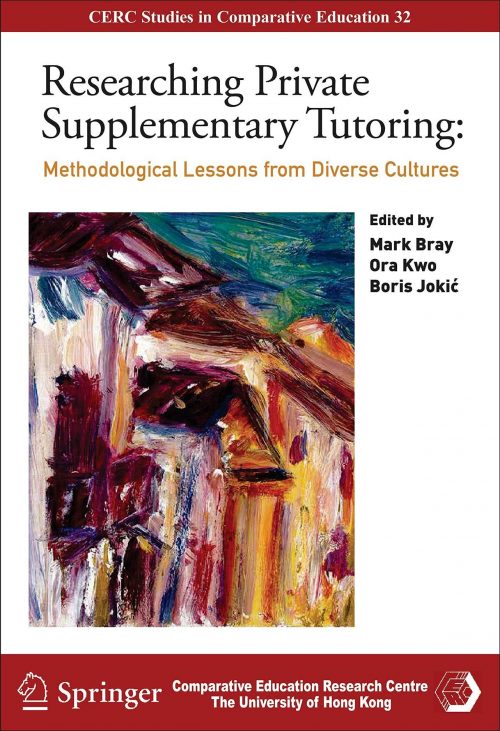
CERC-32-coverLater that week I joined the launch of the new CERC book Researching Private Supplementary Tutoring: Methodological Lessons from Diverse Cultures. Two of the editors, Mark Bray and Ora Kwo, led the discussions in conjunction with Zhang Wei who had completed her PhD thesis on this topic in China and with Kevin Yung and Nutsa Kobakhidze who are PhD students working on Hong Kong and Georgia respectively. This is the first book to focus on methods in this explicit field. The launch showed ways in which it had been a community-building exercise for the contributors themselves.
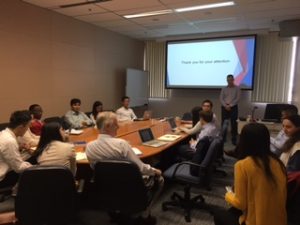
I also wanted of course to learn more about Hong Kong and broader affairs. CERC has many other dimensions to its work, and I was able to join a dozen seminars on a range of topics. I joined several MEd classes in which I found a very vibrant atmosphere. I was able to learn about dimensions of education policy, particularly on language and on dimensions of equity. Through the discussions, I reflected on my own society and in this respect learned even about the Czech education system!

IMG_0118The integration into the SIG and feedback from the CERC colleagues made me think about
shadow education in a wider perspective and conceptualize my findings on a global scale rather than just the European or national context. It was a great privilege and benefit, for which I express appreciation to both CERC and my own University.

UOBI shall also be glad to continue the discussions. Readers are invited to email vit.stastny@pedf.cuni.cz

ECS Workshop: Global Competition and Collaboration Strategies of Research Universities in China and Russia

IMG_0454


IMG_0451Venue: Meng Wah Complex Room 820

(inside the Faculty of Education Library, 8th Floor)

Wednesday Dec. 16, 2015

1:15 pm – Welcoming word from Prof. Mark Bray and Dr. Anatoly Oleksiyenko

1:30 pm – 2:15 pm – Dr. Li Jun

2:15 pm – 3:00 pm – Dr. Shen Wenqin

3:00 pm – 3:45 pm – Dr. Zha Qiang

4:00 pm – 4:45 pm – Dr. Li Aisi

4:45 pm – 5:30 pm – Dr. Ma Jinyuan

5:30 pm – 6:15 pm – Dr. Zhen Gaoming

Thursday Dec. 17, 2015

9:30 am – 10:15 am – Dr. Mark Johnson (on Skype)

10:15 am – 11:00 am – Dr. Igor Chirikov

11:00 am – 11:45 pm – Dr. Alex Kuraev

12:00 pm – 1:30 pm – Lunch at the Senior Commons Room

1:45 pm – 2:30 pm – Dr. Mikhail Lisyutkin

2:30 pm – 3:15 pm – Dr. Sergei Malinovskyi

3:15 pm – 4:00 pm – Dr. Anatoly Oleksiyenko

4:15 pm – 5:00 pm – Concluding remarks from Editors on a Follow-Up Plan

Master of Education: Comparative and Global Studies in Education and Development

Screenshot 2013-12-12 15.16.37The University of Hong Kong has recruited a new cohort of Master of Education students. An information session was held on December 13, 2014  (Saturday) between 2:30-4:30 pm in the Wang Gungwu Lecture Hall, Graduate House, HKU.
Comparison is a fundamental tool for all forms of enquiry. When applied to education in an international setting, it assists in identification of factors which shape education systems, processes and outcomes, and instruments for improvement. The comparisons in this specialism will be framed by theories and understandings of the forces of globalisation. These forces bring benefits for many people, but can also have negative dimensions.

This specialism will examine forces of continuity and change and the implications for educators. It will also focus on the nature of development in an international context and on the role of education in the processes of development. This will include analysis of all levels of formal education (early childhood to higher education), and various types of nonformal education. It will include particular reference to UNESCO’s Education for All (EFA) objectives in the context of the Millennium Development Goals (MDGs).

The specialist modules are:

  • Themes and approaches in the field of comparative education
  • Addressing the global-local nexus in education
  • Education for sustainable development
  • Critical issues in educational reform

In addition to four specialist modules, students will complete:

  • a research methods course “Methods of Research and Enquiry” (2 modules equivalent);
    plus
  • either an option of one elective module and a DISSERTATION (3 modules equivalent),
    or an option of three elective modules and a PROJECT by Independent Study (1 module equivalent).

For further information about this specialism, please contact Professor Mark Bray on (852) 2219 4194, by email: mbray@hku.hk.


MEd-CGSED-2013-a

Education and Humanism: Knowledge for Public Good and Enhanced Humanity in Africa

Speaker: N’Dri Thérèse Assié-Lumumba
Chair: Mark Bray

May 22 at 10:30am to May 23 at 12:00am
Room 202, Runme Shaw Building, the University of Hong Kong

When analyzing contemporary educational systems in Africa, there has been a tendency to focus on formal education that resulted from the colonial experience. Yet, in spite of the profound and sweeping changes that were introduced into the African societies, the foundation and critical dimensions of Africa’s institutions and culture have survived.

This presentation will view the construction of education through the lens of African humanism as popularized by Nelson Mandela and others. The discussion will be allied to the theme of the 2015 annual conference of the Comparative and International Education Society (CIES) in Washington DC: “Ubuntu! Imagining a Humanist Education Globally”.

N’Dri Thérèse Assié-Lumumba is a Professor of African, African Diaspora and Comparative/International Education at Cornell University, USA. She is the Vice-President of Comparative and International Education Society (CIES), and will serve as President in 2015/16. Her early education was in Côte d’Ivoire, followed by France, Canada and the USA. Dr. Assié-Lumumba is a leading scholar with several books, numerous articles and book chapters on various dimensions of education, especially higher education, gender and equity.