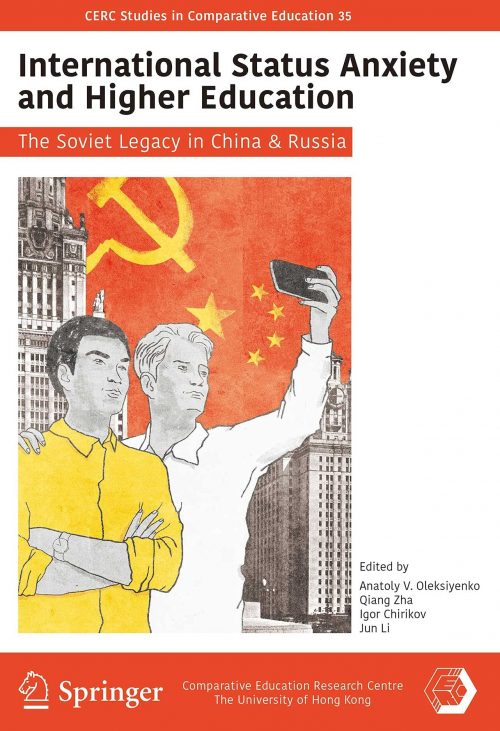
International Status Anxiety and Higher Education – The Soviet Legacy in China and Russia
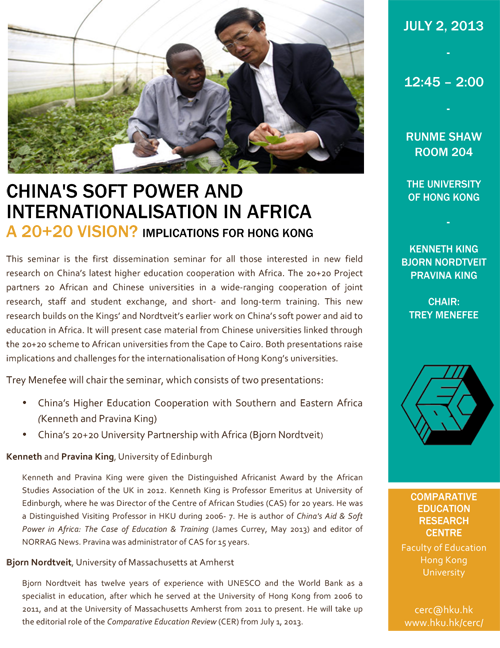
12:45-2:00pm
Tuesday 2 July 2013
204 Runme Shaw Building, HKU Main Campus
Speakers: Kenneth King, Bjorn Nordtveit, and Pravina King
Chair: Trey Menefee
This seminar is the first dissemination seminar for all those interested in new field research on China’s latest higher education cooperation with Africa. The 20+20 Project partners 20 African and Chinese universities in a wide-ranging cooperation of joint research, staff and student exchange, and short- and long-term training. This new research builds on the Kings and Nordtveit’s earlier work on China’s soft power and aid to education in Africa. It will present case material from Chinese universities linked through the 20+20 scheme to African universities from the Cape to Cairo. Both presentations raise implications and challenges for the internationalization of Hong Kong’s universities.
Trey Menefee will chair the seminar, which consists of two presentations:
China’s Higher Education Cooperation with Southern and Eastern Africa (Kenneth and Pravina King)
China’s 20+20 University Partnership with Africa (Bjorn Nordtveit)
Kenneth and Pravina King, University of Edinburgh Kenneth and Pravina King were given the Distinguished Africanist Award by the African Studies Association of the UK in 2012.
Kenneth King is Professor Emeritus at University of Edinburgh, where he was Director of the Centre of African Studies (CAS) for 20 years. He was a Distinguished Visiting Professor in HKU during 2006-7. He is author of China’s Aid &Soft Power in Africa: The Case of Education & Training (James Currey, May 2013) and editor of NORRAG News. Pravina was administrator of CAS for 15 years.
Bjorn Nordtveit, University of Massachusetts at Amherst Bjorn Nordtveit has twelve years of experience with UNESCO and the World Bank as a specialist in education, after which he served at the University of Hong Kong from 2006 to 2011, and at the University of Massachusetts Amherst from 2011 to present. He will take up the editorial role of the Comparative Education Review (CER) from July 1, 2013.
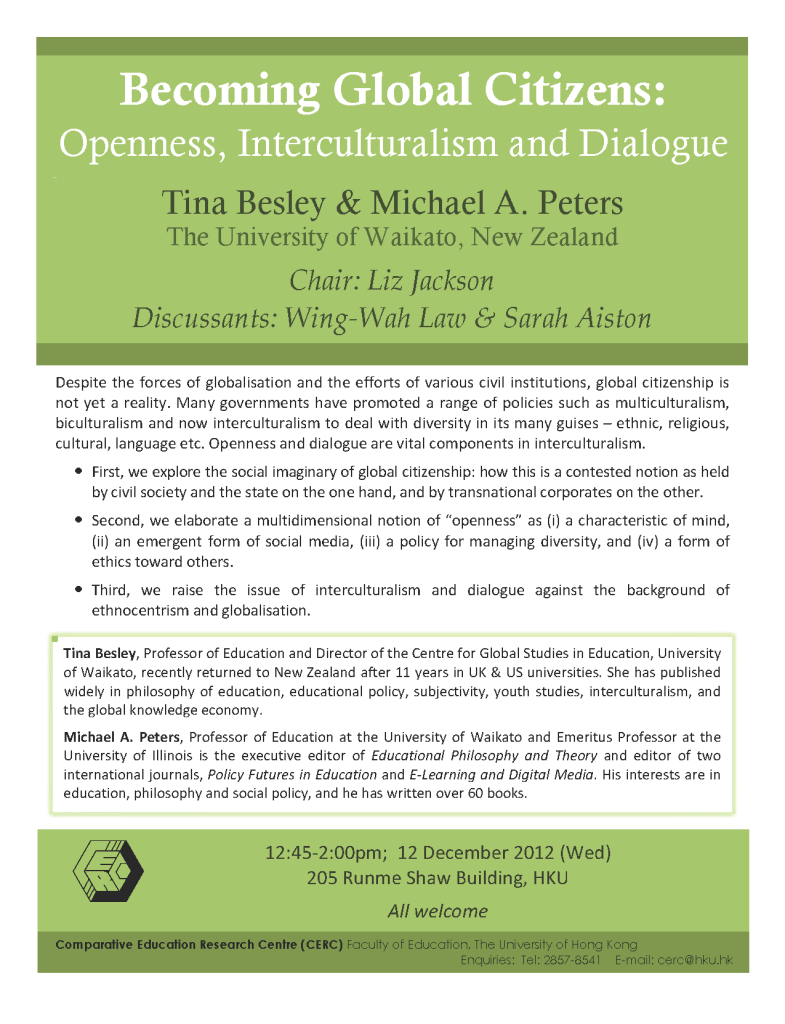
Speakers: Tina Besley & Michael A. Peters
Chair: Liz Jackson
Discussants: Wing-Wah Law & Sarah Aiston
View a slideshow of the seminar:
Despite the forces of globalisation and the efforts of various civil institutions, global citizenship is not yet a reality. Many governments have promoted a range of policies such as multiculturalism, biculturalism and now interculturalism to deal with diversity in its many guises – ethnic, religious, cultural, language etc. Openness and dialogue are vital components in interculturalism.
First, we explore the social imaginary of global citizenship: how this is a contested notion as held
by civil society and the state on the one hand, and by transnational corporates on the other.
Second, we elaborate a multidimensional notion of “openness” as (i) a characteristic of mind, (ii) an emergent form of social media, (iii) a policy for managing diversity, and (iv) a form of ethics toward others.
Third, we raise the issue of interculturalism and dialogue against the background of
ethnocentrism and globalisation.
Tina Besley, Professor of Education and Director of the Centre for Global Studies in Education, University of Waikato, recently returned to New Zealand after 11 years in UK & US universities. She has published widely in philosophy of education, educational policy, subjectivity, youth studies, interculturalism, and the global knowledge economy.
MichaelA.Peters, Professor of Education at the University of Waikato and Emeritus Professor at the University of Illinois is the executive editor of Educational Philosophy and Theory and editor of two international journals, PolicyFuturesinEducation and E-‐Learning andDigitalMedia. His interests are in education, philosophy and social policy, and he has written over 60 books.